

 rimmabondarenko
Mental health as a generational question
ed* No. 02/2025 – Chapter 3
For Generation Z, meaning those born between the mid-1990s and the early 2010s, mental health is no longer a taboo, but a topic of central importance. Unlike previous generations, Gen Z speaks openly about stress, anxiety, and exhaustion. At the same time, the number of sick leave cases due to mental illness has been rising for years, especially among young employees.1
The reasons for this are diverse. An uncertain world of work, constant availability, high expectations for performance and self-optimisation, but also loneliness and isolation, especially in digital work models, put more pressure on Gen Z than seemed to be the case for earlier generations. While working from home offers more flexibility for all employees, it also takes away the social anchor that work used to represent, particularly for many young people. There is also the fact that entering the labour market today often happens in fixed-term or project-based employment without long-term security or perspective.
Mental Health
The European Commission is increasingly committed to promoting mental health in Europe. It pursues a holistic approach that encompasses prevention, early support and destigmatisation of mental illness. In 2023, the Commission presented a comprehensive mental health initiative aimed at raising awareness, improving care and supporting vulnerable groups. The goal is to treat mental health as equal to physical health.
The Framework Directive on occupational safety obliges employers to avoid hazards to the safety and health of employees and to assess and combat risks. However, the directive remains unspecific with regard to psychological stress. There are no mandatory requirements on how to conduct or document psychological risk assessments. This leads to inconsistent implementation across member states. Some countries, including Germany, have detailed national rules that require a psychological risk assessment, while others, such as Romania and Spain, hardly do.2 For this reason, Members of the European Parliament and the European Trade Union Confederation have long called for a European directive on psychosocial risks. Such a directive is intended to give priority to combating work-related stress and mental health problems resulting from psychosocial risks.
Unlike noise or employee exposure to hazardous substances, psychological stress at the workplace cannot easily be measured with instruments. Occupational safety must therefore become more dialogue-oriented throughout Europe and actively involve employees in assessing their work situation. It is no longer only about preventing accidents, but also about shaping workplaces jointly so that workers remain physically and mentally healthy. In addition to workplace health management and raising awareness among managers, strong prevention and early detection are needed.
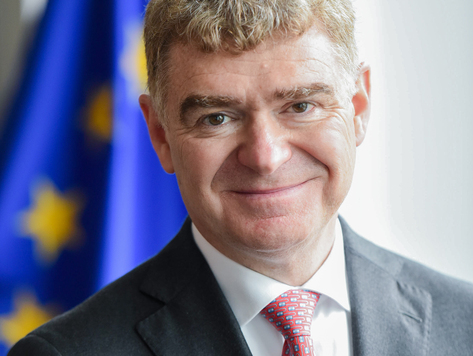
In the EU, we have strong rules that protect people against health and safety risks at work. Because our lives and our work environments are constantly changing, we continuously update these laws. Working remotely, for instance, brings great benefits and great challenges – and mental health at work is a growing concern. This is why the Commission is considering explicitly addressing psychosocial risks at work.
The new working reality of younger generations requires a new understanding of work. Occupational safety is the central hub that determines how this understanding can find its place within today’s structures. Only through the continuous development of good working conditions for today’s and future generations can the foundation be created for a resilient working population in Europe.